While concrete is the world’s most used manmade material, its carbon footprint accounts for around 8% of global greenhouse emissions.
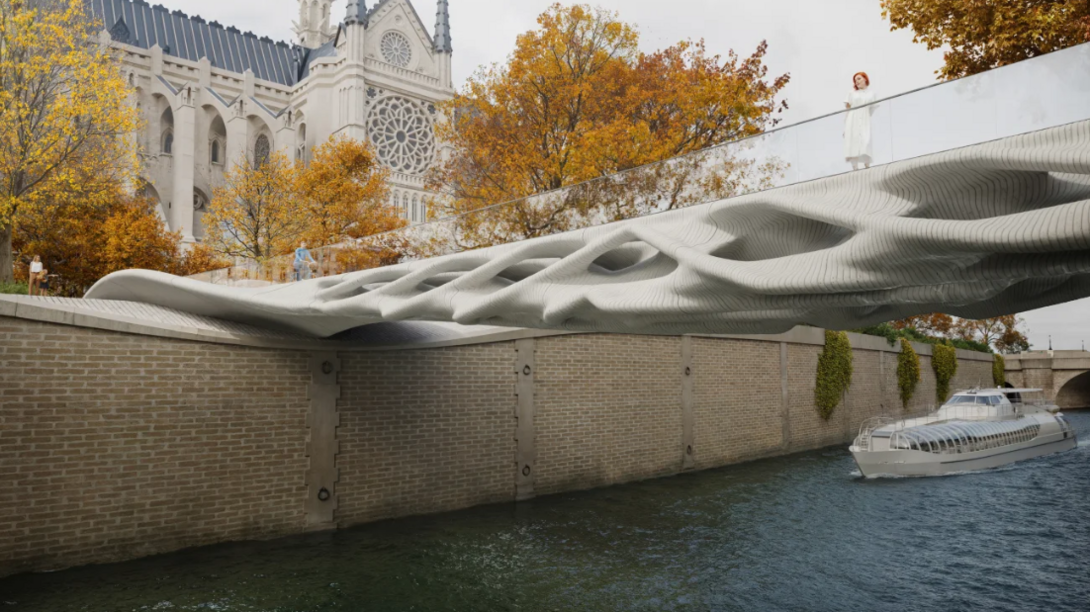
Polyhedral Structures Laboratory, a research team from Penn and a tenant at Pennovation Works, has been working on a project called Diamanti. This project features a 3-D printed lattice-like pattern made from a sustainable concrete mixture using diatomaceous earth.
Their first prototype using this material was a 3-meter scale model that has been on display at the European Cultural Center in Venice, Italy, since May 10, 2025. The exhibition closed on October 23, 2025.
The team has taken inspiration from nature, bone porosity specifically, which has aided in increasing the surface area of the bridge and increasing the carbon absorption potential. Most concrete has been shown to absorb roughly 30% of the amount of carbon dioxide that its production emits, but Diamanti’s enhanced mixture absorbs 142% more CO2 than traditional concrete mixes.
The project was recently approved to construct its first bridge in France, where the team will test their designs and hopefully create “a whole new world of possibilities” for concrete, says Masoud Akbarzadeh, an associate professor of architecture at the University of Pennsylvania and director of Polyhedral Structures Laboratory.
The lab is also constructing a version of Diamanti on the grounds at Pennovation Works that will be completed by early November.
Read more about Polyhedral Structures Laboratory and Diamanti in CNN Science.